
A disciplined review of four small multifamily opportunities in Fort Lauderdale and Opa-locka—and what it takes to approach a 10% stabilized cap rate without confusing projections with guarantees.
South Florida multifamily investment opportunities can look compelling on the surface—but advertised cap rates rarely tell the whole story. For international buyers, especially investors comparing U.S. real estate with opportunities in Italy and Europe, the real question is not simply which property offers the highest headline yield. It is which asset can deliver durable income after acquisition costs, repairs, insurance, taxes, professional management and legal verification.
Our preliminary review of small multifamily properties in Fort Lauderdale and Opa-locka identified four different strategies: immediate income, local value-add, subsidized-income stability and a more operationally intensive repositioning. The analysis below is based on public listing information checked on August 4, 2026. Availability and advertised figures may have changed.
Why a 10% cap rate requires disciplined underwriting
A genuine 10% capitalization rate is unusual in the current South Florida market at the advertised purchase price. In the reviewed listings, Fort Lauderdale apartment properties were generally marketed closer to the mid-6% range, while stabilized Opa-locka assets were more often presented between approximately 7% and 8%.
Reaching a 10% stabilized cap rate therefore normally requires one or more of three conditions:
an asset already producing income close to the target;
a meaningful discount to the asking price; or
documented rent, expense or operational upside that can be executed legally and realistically.
The key word is documented. Pro-forma rents, informal unit counts or incomplete expense statements should never be treated as dependable net operating income.
1. Fort Lauderdale: the strongest immediate-income candidate
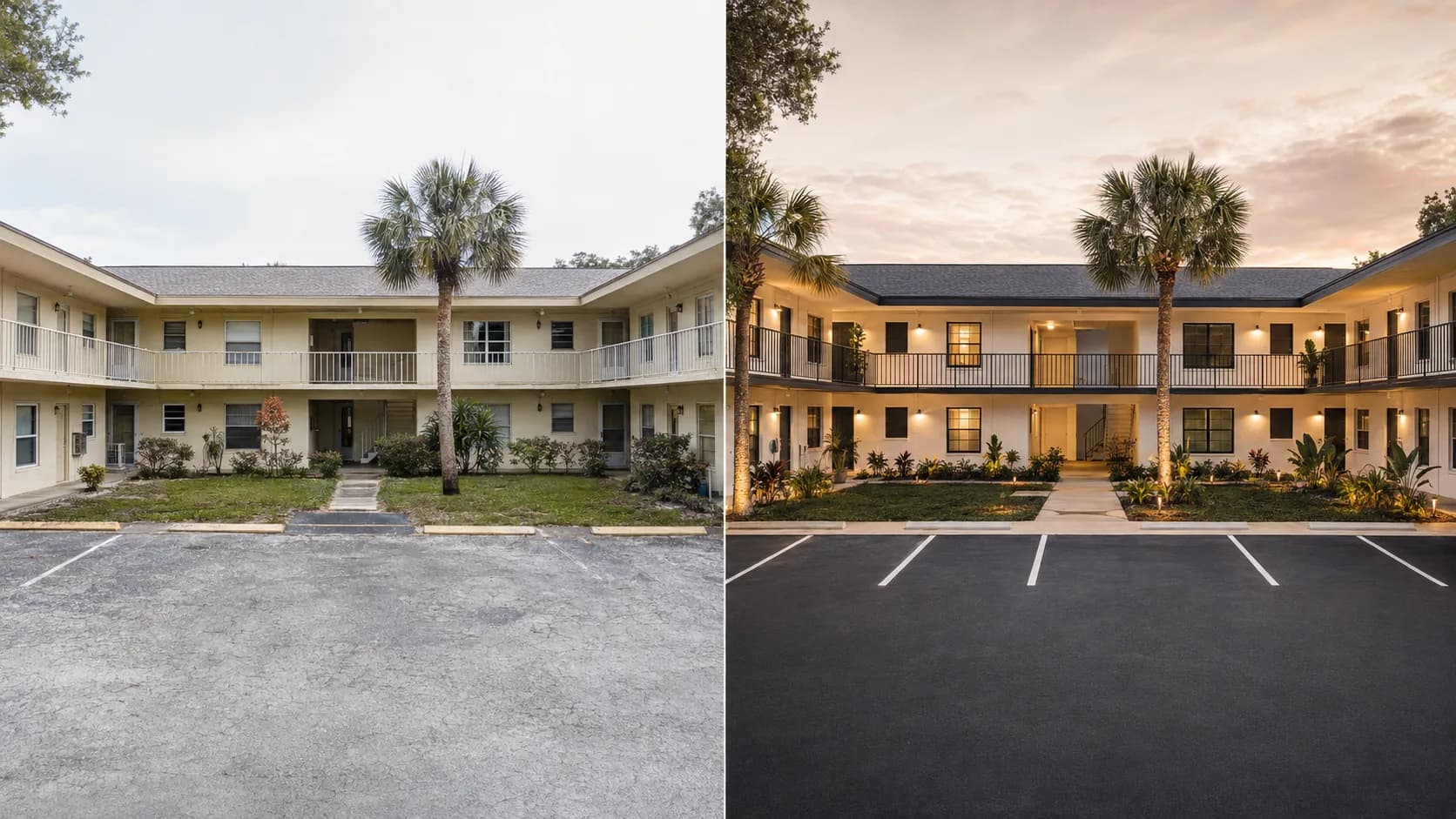
The first opportunity is a six-unit, two-story multifamily property in the Melrose Park area of Fort Lauderdale. The public listing indicated an asking price of $1,248,990, approximately 6,520 square feet, full occupancy and a published cap rate of 9.40%.
At that advertised cap rate, estimated annual NOI is approximately $117,405. An illustrative all-in capitalization of $1.17 million—including purchase price, closing costs, legal review, inspections and an immediate repair reserve—would produce a calculated cap rate of approximately 10.03%.
This makes the asset the closest of the four to the income target. However, the result is only credible if the reported NOI includes realistic management, repairs, reserves, current insurance and reassessed property taxes. The legal status of all six units, together with the roof, plumbing, electrical panels and HVAC, must also be independently verified.
2. Opa-locka: an 11-unit value-add portfolio
The second opportunity combines 11 units across two multifamily properties and one single-family residence in Opa-locka. The portfolio was marketed at $1,495,000, or approximately $135,900 per unit, with month-to-month tenancies and rents reported below market.
That tenancy profile may create a faster path to repositioning than a fully stabilized property, provided rent changes, renovations and leasing are handled lawfully. Under an illustrative stabilized model of $1,850 per unit per month, 6% vacancy and collection loss, and operating expenses equal to 43% of effective income, estimated NOI would be approximately $130,842.
At an illustrative total capitalization of $1.35 million, the projected stabilized cap rate is approximately 9.69%. Reaching a full 10% would require a lower acquisition basis near $1.13 million or stronger verified rents. Before assigning value to that upside, an investor would need the complete addresses, legal unit count, current rent roll and operating expenses.
3. Opa-locka: stable Section 8 income with a pricing challenge
Bel-Air Apartments at 1265 Sharazad Boulevard presents a different profile: 14 units, reported 93% occupancy, an asking price of $2.7 million, an in-place cap rate of 7.17% and a seller pro-forma cap rate of 8.30%.
The attraction is potentially stable subsidized income and additional upside from laundry revenue and remaining interior improvements. The challenge is basis. Using seller pro-forma NOI of $224,100 and an illustrative total capitalization of $2.2 million, the calculated cap rate would be approximately 10.19%.
That outcome depends on substantial price negotiation and full verification of HAP contracts, Section 8 inspections, payment history, tenant balances, property-tax reassessment, insurance renewal costs and the assumptions behind the seller's pro forma.
4. Fort Lauderdale: eight units with a critical zoning question
The fourth property is an eight-unit building at 426 NW 14th Avenue in Fort Lauderdale. Public marketing indicated an asking price of $1.49 million, a 6.88% cap rate, approximately $102,512 in current NOI and a 3,648-square-foot building on roughly 0.27 acre.
An illustrative $1.3 million all-in capitalization would require $130,000 in NOI to reach a 10% cap rate—approximately $27,500 more annual NOI than the current indication. Depending on expenses, that could require roughly $350 to $400 in additional monthly revenue per unit.
The more important issue is legal. Reported RS-8 zoning appears inconsistent with an eight-unit apartment building. An investor must confirm legal nonconforming status and determine whether all eight units could be rebuilt after a substantial casualty. No operational upside can compensate for unresolved unit legality or rebuild risk.
The due-diligence checklist that protects the investment
Before presenting any South Florida multifamily opportunity as capable of achieving a target return, investors should independently verify:
the current rent roll, tenant ledger and every lease or month-to-month agreement;
trailing 12-month income and expenses, plus prior-year operating statements;
security deposits, prepaid rents, arrears, concessions and pending evictions;
current taxes and the likely reassessment at the proposed purchase price;
insurance premiums, deductibles, loss runs and renewal indications;
legal unit count, certificates of use, zoning and open permits;
utility, landscaping and vendor expenses;
roof, plumbing, electrical, HVAC and structural condition;
survey, title, flood-zone and environmental findings; and
capital-expenditure history and realistic renovation reserves.
For subsidized housing, HAP contracts, inspection reports and any payment abatements require an additional layer of review.
The investment takeaway
These four assets illustrate why successful value-add investing is less about chasing the highest advertised cap rate and more about controlling basis, validating NOI and identifying upside that can actually be executed.
For an income-first strategy, the six-unit Fort Lauderdale property deserves priority—subject to verification of the advertised 9.40% cap rate. For a value-add strategy, the Opa-locka portfolio offers the most flexible repositioning thesis, but only after the unit count, rents and expenses are confirmed. Bel-Air Apartments may appeal to investors seeking subsidized-income stability, while the eight-unit Fort Lauderdale property requires zoning clarity before serious underwriting.
Life Changing Homes works with international buyers to identify, evaluate and manage real estate opportunities across South Florida and Italy. Explore Life Changing Homes or contact our team to discuss a tailored acquisition strategy.
Important notice: This article is based on preliminary underwriting and public listing information checked on August 4, 2026. It does not constitute legal, tax, investment or securities advice. Figures are illustrative, property availability may change, and no return or cap rate is guaranteed. Foreign investors should obtain independent U.S. and home-country legal and tax advice before acquiring or financing U.S. real estate.